MILITARY VEHICLE PRODUCTION IN EAST GERMANY
CIA/RR IM-371
27 March 1953
WARNING
THIS MATERIAL CONTAINS INFORMATION AFFECTING THE NATIONAL DEFENSE OF THE NITED STATES WITHIN THE MEANING OF THE ESPIONAGE LAW, TITLE 18, USC, SECS. 793 AND 794, THE TRANSMISSION OR REVELATION OF WHICH IN ANY MANNER TO AN UNAUTHORIZED PERSON IS PROHIBITED BY LAW.
LIMITED DISTRIBUTION IAC Agencies Only
CENTRAL INTELLIGENCE AGENCY Office of Research and Reports

Table of pages

CIA/RR IM-371
(ORR Project 37.3)
MILITARY VEHICLE PRODUCTION IN EAST GERMANY*
* This report contains information available to CIA as of 15 January 1953 and reflects source information dated no later than August 1952.
Summary
The production of military vehicles in East Germany was initiated in mid-1951 to meet the needs of the expanded East German paramilitary forces and the embryonic East German military establishment. The USSR remains responsible for supplying East German forces with armored vehicles, but their military transport requirements must be supplied from domestic production. To handle the procurement of military vehicles and other military end items, the East German government has established a special agency, the Office for Economic Questions. The Administration of People-Owned Enterprises for Motor Vehicle Production manufactures the vehicles. All phases of military vehicle production in East Germany are closely coordinated with Soviet authorities, who accord military procurement a prior claim on the East German economy, equal to Soviet quotas for reparations.
Available information indicates that total East German requirements for military vehicles have not been firmed up. Tentatively, the planned requirements may be estimated at about 25,000 vehicles. Three classes of military vehicles with good cross-country characteristics have been developed and are believed to be in serial production. These are a light personnel carrier, a medium truck, and a heavy full-tracked carrier. The production target for 1952 was 4,402 such vehicles. It is estimated that only 3,252 vehicles, or 74 percent of the target figure, were produced in 1952, This failure to fulfill the plan was caused by shortages of the materials and equipment necessary to produce component parts such as engines and gears.
I. Introduction.

On 1 January 1953, Wilhelm Pieck, President of the Deutsche Demokratische Republik (DDR), warned that the DDR would be forced to create national armed forces in order to protect Socialist achievements in East Germany from "Western imperialism." 1/* Such action would be formal recognition of activity which has been under way since the fall of 1950. During the second half of 1950 and the early months of 1951, the expansion of paramilitary police forces in the DDR (the HV der VP and the VPG) and the establishment of embryonic army, navy, and air elements (the KVP, the VPL, and the VPS, respectively) created the problem of equipping these forces.** 2/ On 12 June 1951, General Makarov of the Soviet Control Commission (SCC) announced that no further deliveries of trucks from the USSR would take place. 3/ This announcement meant that DDR requirements for military vehicles would have to be satisfied by the Germans themselves. 4/***
It is the purpose of this report to trace the production of military vehicles in the DDR by examination of the over-all planning for such production, procurement procedures, production organization, and the current progress of production.****
* Footnote references in arabic numerals are to sources listed in Appendix B.
** The paramilitary police forces consist of the People's Police (Hauptverwaltung der Volkspolizei, HV der VP) and the Border Police (Volkspolizei der Grenze, VPG). The military elements consist of the Garrisoned People's Police (Kasernierte Volkspolizei, KVP); the People's Air Police (Volkspolizei Luft, VPL); and the People's Sea Police (Volkspolizei See, VPS). Throughout this report, the KVP, the VPL, and the VPS will be used to designate the East German ground, air, and sea forces, respectively.

The military forces and the Border Police are supplied by the Ministry of the Interior (covert defense ministry). The People's Police are supplied by the Ministry of State Security.
*** It has since become evident that armored fighting vehicles (AFV) and artillery are being supplied by the USSR. 5/
**** The term military vehicles can be applied both to normal commercial vehicles in the hands of military units and to special vehicles designed primarily for military use and with good crosscountry characteristics. In this report emphasis will be on the latter usage.
II. Objectives of Production.
A. Total Estimated Requirements.
Total East German vehicle requirements are not known to intelligence, and there is good evidence that East German authorities themselves have not established firm and realistic goals. In June 1952 a high official of the Ministry of Interior (the covert defense ministry) was advised by his staff that by the end of 1952 the KVP would have some 10,000 vehicles. 6/ Moreover, he was told that if production progressed at the rate contemplated, the KVP would hold 30,000 vehicles by the end of 1953, which would require 50 percent of the entire KVP as of that time to operate. 7/
Nevertheless, an estimate of total requirements can be made. The largest consumer of military vehicles is the KVP. It is believed that the KVP is being organized into three corps of three divisions each. 8/ These divisions are modeled on Soviet tables of organization. 9/ A minimum of 13,725 and a maximum of 19,120 vehicles would be required by the KVP. 10/ The exact figure will depend on the type of division formed. The ultimate requirements of other formations such as the VPL, the VPS, and the VPG, on the basis of their contemplated size and current procurement rates, are estimated not to exceed 10,000 vehicles. 11/ A rough estimate of total East German requirements would be 25,000 vehicles. It is emphasized that the above discussion is an attempt to estimate the probable magnitude of the production effort and does not represent order-of-battle intelligence.
B. Production Plans for 1952 and 1953.
Specifications for three distinct classes of military vehicles have been developed in East Germany. 12/ These are a light vehicle capable of carrying personnel and towing light equipment, a medium vehicle capable of transporting 5- to 6-ton trailer loads, and a heavy-tracked vehicle which can transport loads of 8 tons or more. 13/
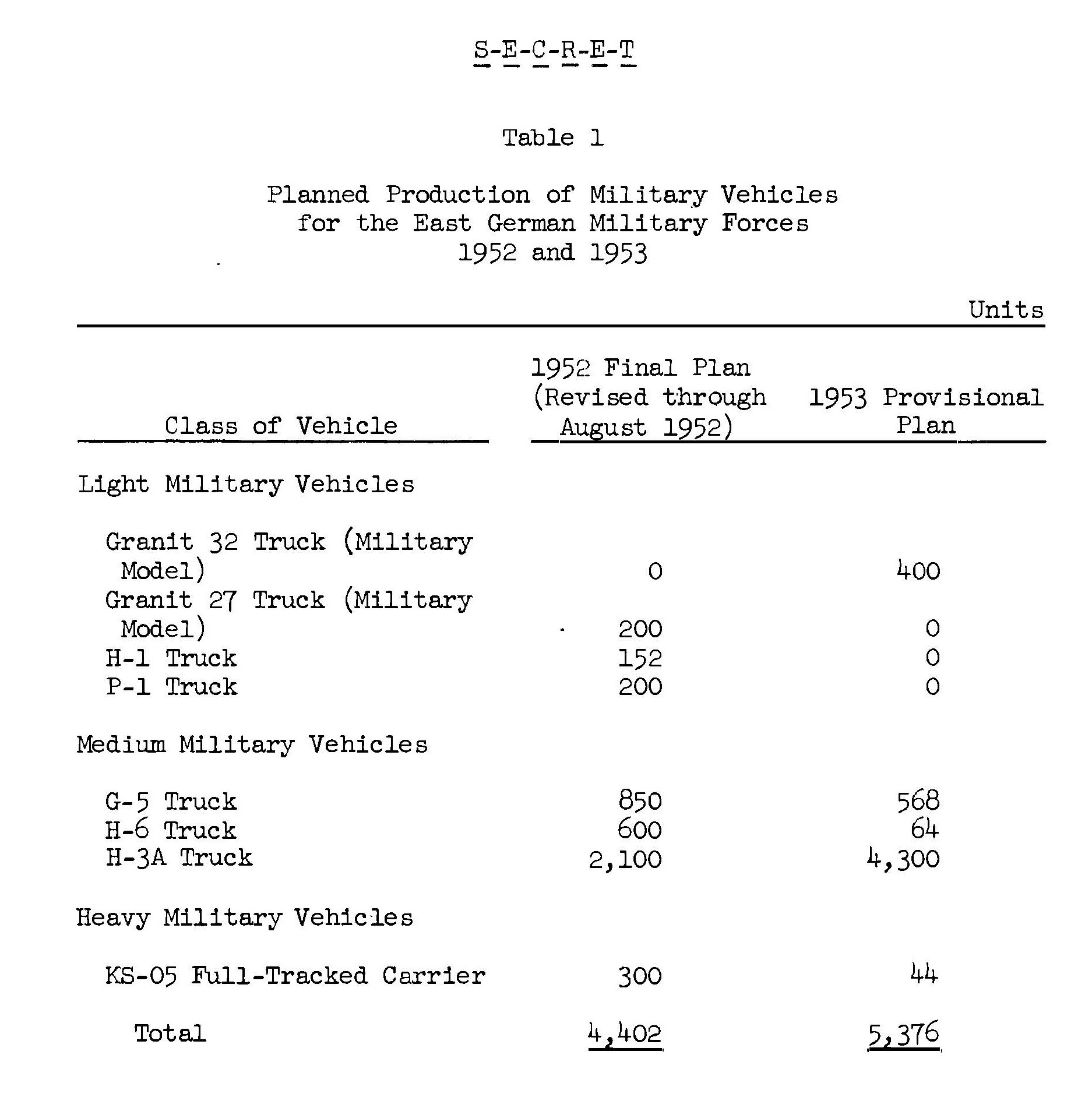
Planned production of these three classes of military vehicles, broken down by model, is tabulated in Table 1,* which contains the 1952 Final Plan (revised through August 1952) and the 1953 Provisional Plan.
* Table 1 follows below [on p.4. originally]
 III. Procurement, Expediting, and Control of Production.
A. Participating 0rganizations.
III. Procurement, Expediting, and Control of Production.
A. Participating 0rganizations.
Four organizations are directly involved in the procurement, expediting, and control of the production of military vehicles. These are the military office which is the ultimate consignee; the Administration of People-Owned Enterprises for Motor Vehicle Construction (Verwaltung Volkseigener Betriebe fuer Industrie Fahrzeug Ausstellung, VVB IFA), which manufactures the vehicles; the SCC, which exercises final policy control over production; and the Office for Economic Questions (Buero fuer Wirtschaftsfragen, BfW), which coordinates procurement and expedites production. 14/ The BfW is the key organization in the military vehicle procurement program and all other military procurement programs as well. 15/ It commenced operations on 1 March 1951 under the direction of Willi Stoph, who has since become titular Minister of the Interior (the covert defense minister). 16/ The BfW, now headed by Berndt Weinberger, is directly responsible to Stoph. 17/
B. Procurement Procedure.
The central position of the BfW and the interrelationship of the various organizations mentioned above can best be illustrated by a discussion of military vehicle procurement procedure. This procedure can be divided into three phases: the planning of orders, the placing of orders, and the fulfillment of orders. 18/
In October 1951 the various military establishments were ordered to prepare rough estimates of their military requirements for 1952. 19/ After these estimates had gone to the SCC for approval, they were registered in the BfW planning section, Division I, which forwarded the Provisional Plan for military vehicles to the chief of the BfW Division II, Equipment for Ground Forces, and to Robert Hoffmann, chief of the Motor Vehicle Section of Division II. 20/
It was then the task of Hoffmann and his division chief to determine whether or not DDR industry was capable of satisfying the estimated requirements. 21/ To that end they conferred with representatives of IFA, and with various suppliers of raw materials and components to IFA, to determine to what extent the Provisional Requirements could be fulfilled by DDR's own industry, to what extent imports would be necessary, and which requirements would have to be canceled altogether. 22/ The Provisional Requirements were then returned to the various military establishments with the BfW's conclusions on the subject. 23/ The military planners then drew up more accurate plans in which they restricted their requirements to the level outlined by BfW. 24/ This Final Plan was returned to the BfW, which, after obtaining final approval from the SCC, passed the Final Plan on to industry in the form of government orders. 25/ These government orders specify the exact quantity to be delivered in each quarter and the technical terms of delivery. 26/ When an order is completed, the BfW notifies the military customers, who send representatives to collect the vehicles. 27/ At the same time the BfW sends its own representatives to witness actual delivery of the vehicles and receive the bill from the manufacturer. 28/ The bill is delivered to the finance office of the BfW, which pays the firm in question within 14 days. 29/
Government orders issued by the BfW have a priority over all other orders. 30/ Therefore, any delay in the process previously described greatly handicaps the entire East German economy, since the various segments of DDR industry are forced to adjust their own plans to meet these BfW orders, and until the Final Plan is approved by the SCC and released by the BfW, they cannot do so. 31/ In the case of requirements for 1952, the Final Plan was still in the process of preparation by the military establishments in January 1952. 32/ The military forces were ordered to submit the Provisional Plan for the year 1953 in June of 1952 rather than in October, so as to rectify this situation. 33/
After the Final Plan for 1952 was approved and orders were placed, there was still constant revision throughout 1952.34/ The primary reason for the revision was the failure of the system of component parts supply because of shortages of production equipment or raw materials, and a consequent failure by the manufacturers to meet quarterly targets. 35/ Revisions also were caused by the SCC, which suddenly demanded production of some new vehicle or the abandonment of a production program already under way. 36/ These questions were solved after endless negotiation between the SCC and the BfW; the BfW has displayed a surprising amount of independence in its dealings with the SCC. 37/
IV. Production Facilities.
The actual manufacture of military vehicles is the task of IFA. 38/ This grouping of more than 40 vehicle and vehicle accessories plants is subordinate to the Ministry for -Heavy Machine Construction. 39/
A. Operations, 1950-52.
Production of military vehicles by IFA can be divided into three phases. The first phase extended from mid-1950 to mid-1951, During this period, IFA was beginning, with the help of the First Two Year Plan (1949-50), to recover from war damage and the effects of Soviet reparations. 40/ Production of commercial vehicles on a limited scale was in progress, and the expanding military forces were being equipped with a hodgepodge of commercial vehicles and surviving World War II equipment. 41/ During the second phase, from mid-1951 to mid-1952, IFA, while continuing to expand production of commercial vehicles, undertook limited assembly of World War II model vehicles, using wartime parts, jigs, dies, and so on. 42/ Moreover, on orders from the SCC, IFA designers at the IFA Research and Development Plant in Chemnitz were engaged in the testing of prototype military vehicles based in most cases on combinations of earlier German and foreign designs. 43/ There has been no attempt to produce Soviet-model vehicles in East Germany.* The third phase commenced in July 1952 and will continue throughout 1953. 44/ IFA is now concerned with the serial production of these newly designed military vehicles as well as various commercial models. When sufficient military vehicles have been produced to meet military needs, some military models will be sold to various industrial enterprises. 45/
B. Plants.
Most of the IFA vehicle and vehicle accessories plants have a role in military vehicle production. 46/ In addition to the Research and Development Plant at Chemnitz, the most important military vehicle plants are the Horch Motor Vehicle Plants in Zwickau, the Phaenomen Motor Vehicle Plants in Zittau, the Framo Motor Vehicle Plant in Hainichen, the IFA Gear Works in Liebertwolkwitz near Leipzig, and the IFA body building plant in Halle. In addition, there are two important plants belonging to the Administration of People-Owned Enterprises of Locomotive and Railroad Car Construction (Verwaltung Volkseigener Betriebe fuer Lokomotiv und Wagenbau Ausstellung, VVB WWA). The LOWA plant at Werdau and the LOWA plant at Bautzen became involved in military vehicle production early in 1952. 47/ Since most of the railroad products which formerly came from these two LOWA plants went to the Soviet Reparations Commission, their use for military vehicle production has no great effect on East German railroads. 48/ However, the transfer of these plants does demonstrate that it is Soviet policy to give the equipment of East German armed forces priority over railroad equipment reparations. Furthermore, certain Soviet-owned. (sowjetische Aktiengesellschaft, SAG) plants have received instructions to support IFA and other East German industries in fulfilling BfW orders.49/ The SCC instructed the SAG plants to give orders from the BfW a priority equal to that of reparations. 50/
* Intelligence coverage is sufficient to permit this statement.
V. Progress in Production.
A. General.
Progress in the production of military vehicles has been considerably delayed by material shortages and by a lack of machine tools and other production equipment, as will be pointed out in succeeding sections dealing with individual models. The basic lack is one not of capacity for vehicle assembly, but of component production facilities, particularly for engine manufacture. Table 2* [inserted below] shows over-all progress in terms of the planned production, actual production as of 3l June l952, and estimated actual production for the year. The last estimate was made on the basis of stated or implied ability of the manufacturers of component parts to meet their quotas.
 B. Light Military Vehicles.
The ultimate light military vehicle will be a military model of the Granit 32 truck designed for towing 75-mm or smaller guns, signal equipment, and trailers. 51/ This vehicle was scheduled for serial production in 0ctober 1952. 52/ Before this time, demand for this vehicle class was met by a military version of the Granit 27 truck and by two stopgap designs, the P-l and H-l trucks. 53/
l. Granit 32 Truck (Military Model).

The military model of the Granit 32 truck is a 2-ton, 50-hp diesel-powered vehicle. 54/ It differs from the civilian model Granit 32 in that it has all-wheel drive for cross-country purposes. 55/ It will be produced by the Phaenomen Plants in Zittau. 56/
2. Granit 27 Truck (Military Model).

The military model of the Granit 27 truck is identical to the military model Granit 32 except that a gasoline engine is used. 57/ The Granit 27 is not a new design; some 25,000 were produced for use by the Germans during World War II. 58/ When it was decided in March 1952 that production of the H-1 and P-1 trucks would be discontinued, the SCC agreed to manufacture 200 50-hp military models of the Granit 27 before the contemplated switch to military model Granit 32 production in October 1952. 59/ Orders were given that a prototype military model Granit 27 be built at the Phaenomen Plant in Zittau for demonstration to General Vasiliy Chuikov, of SCC, on 15 April 1952, 60/ This prototype was completed ahead of schedule on 5 April 1952, and its demonstration to the sec was a success. 62/ Its towing capacity and climbing ability were far superior to the H-1 vehicle on which the DDR military forces had previously been dependent. 63/
3. H-1 Truck.

The H-1 truck, known during World War II as the KFZ-15, is a 2-ton, 80-hp cross-country command end staff vehicle. 64/ The reason for its postwar production was the utilization of spare parts on hand. 65/ By April 1952 the BfW had received clear orders from the SCC that the H-1 was only a stopgap solution to the light towing problem and was to be abandoned after limited 1952 production had been completed. 66/ Thirty of these vehicles were assembled during 1951, and 152 additional units were to be assembled at the Framo Plant in Hainichen during 1952. 67/
4. P-1 Truck.

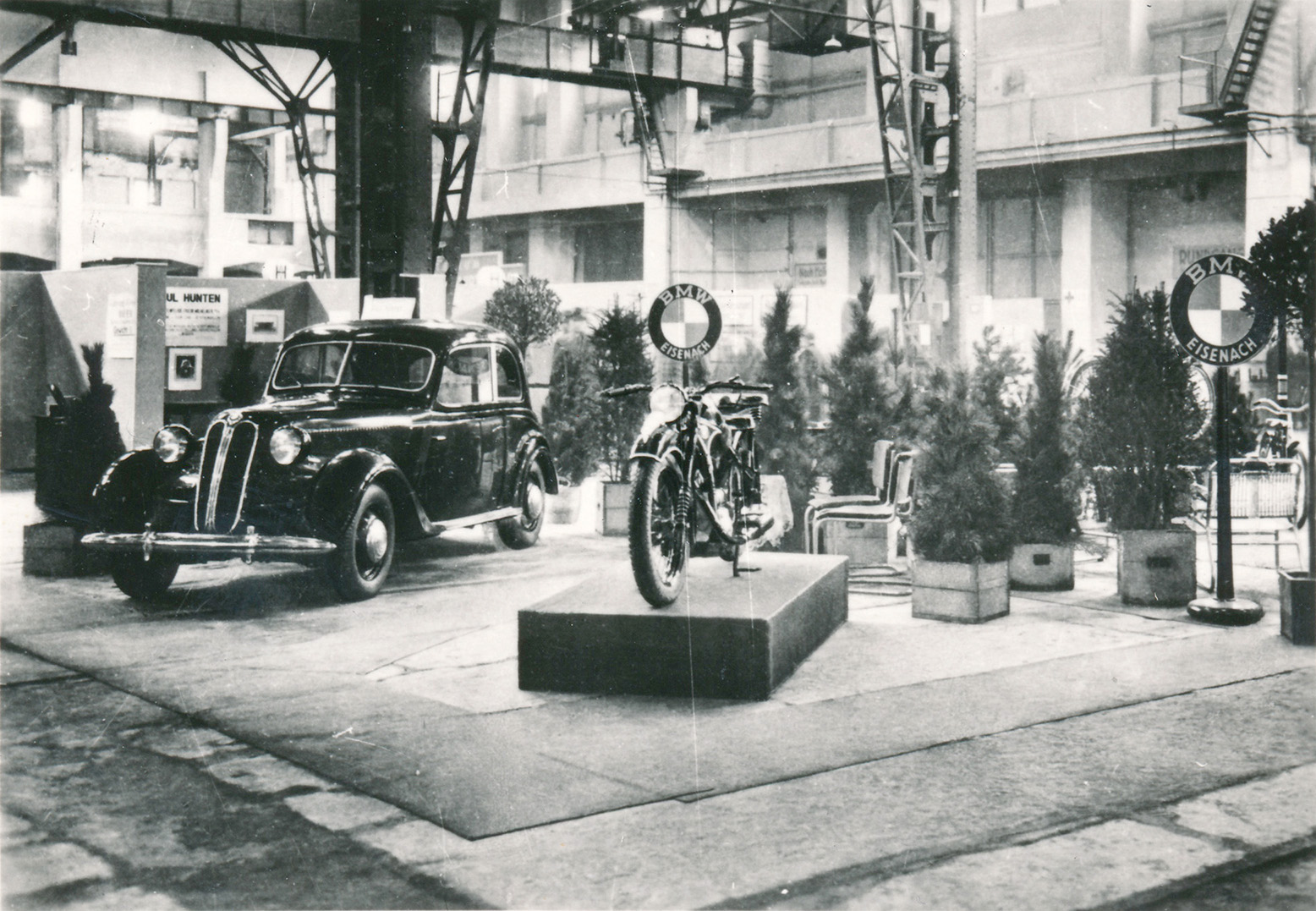
Another stopgap solution to the light towing problem was the P-1 vehicle. The P-1 was not intended for towing purposes but was a communications and personnel vehicle designated during World War II as KFZ-2. 68/ Because of the lack of suitable engine and engine production facilities, the P-1, like the H-1, was regarded as makeshift for 1952, and production was expected to be discontinued by 1953. 69/ One hundred and sixty of these P-1 vehicles were ready for trial in April 1952, and production was not expected to exceed 200 units for the year. 70/ The P-1 is produced by the former BMW (Bavarian Motor Works) plant in Eisenach. 71/
https://dkwautounionproject.blogspot.com/2024/07/1956-ifa-p2m-gelandewagen.html
C. Medium Military Vehicles.
The pre-eminent vehicle in the medium class is the G-5 truck. This truck is a cross between the Soviet ZIS 151 and the three-axle Krupp model used by the Germans in World War II. 72/ It is a 5-ton truck capable of carrying 5- to 6-ton loads and is reported to be especially suited for drawing 122-mm or 152-mm artillery pieces. 73/ The SCC continually stressed the importance of G-5 production as a target during 1952. 74/
Another vehicle in this class is the Horch H-6 6-ton truck which embodies the same engine, gear box, and transmission as the G-5. 75/ During April 1952 the originally planned production figure of 1,500 H-6 vehicles was cut to 600 in order to give priority to G-5 production. 76/ Five hundred of these are to go to a state vehicle reserve being organized by a so-called "Office for Government Contracts" with the understanding that they will be made available to the military in case of an emergency. 77/
The H-3A, a 3-ton diesel-powered commercial truck which has been in production for some time, was found unsuitable for heavy-duty cross-country use. Plans are under way for its redesign and the eventual production of a military model in 1953. 78/
1. G-5 Truck.

On 12 June 1951, at a conference among members of the sec, the BfW, and the KVP, General Makarov insisted that work commence immediately on a three-axle cross-country vehicle of the ZIS 151 type with drive on all axles. 79/ Plans of the ZIS 151 were secured, and blueprints of the new G-5 vehicle were ready on 25 June 1951. 80/ During June 1951 a contract was let for the construction of a new 180-hp air-cooled diesel for this vehicle. 81/ Until the new engine could be supplied, the 120-hp engine used in the Horch H-6 vehicle was to be installed in the G-5.82/ The first prototype G-5 was to be finished by 21 December 1951. 83/
Plans had been made to produce 1,750 of the G-5 vehicle during 1952, but it became obvious as early as January 1952 that this was too optimistic a figure. The LOWA plant in Werdau, which was to produce the G-5 serially, was informed on 7 January that planned production of the G-5 was to be only 850 vehicles. 84/ Early in March 1952, officials of the BfW visited Werdau to check on progress there. The original aim had been 25 G-5 trucks in June, 120 in July, and further proportional increases throughout 1952. 85/ The fact of the matter was that Werdau reported probable production of only 5 G-5's in June and possibly 100 in July. 86/ This progress was unsatisfactory to the BfW, which had hoped to distribute the 25 vehicles planned for June among various KVP units for trial. 87/ BfW also planned to convert to special uses the 120 vehicles scheduled for production in July. The conversion of these vehicles to special-purpose units -- for example, mobile cranes, mobile microwave radio stations, and mobile workshops – would entail 4 or 5 months’ further development at various body building firms. 88/ In order to complete production of these units during 1952, it was essential that the original plan be adhered to, and therefore the BfW insisted on the original target. 89/
The lag in production was caused by difficulties in securing an adequate supply of starters, crankshafts, steering shafts, transmission shafts, gears, and glass. 90/ Paramount among these difficulties were the fabrication of a special steel die so that the crankshafts could be forged in one piece and the lack of special Gleason machinery for the production of gears. 91/ lt is not known what success has been obtained in solving the problems connected with manufacturing crankshafts. For the production of the gears required for the G-5, only three Gleason machines were available in the DDR, whereas at least six were needed. 92/ Consequently, a special task force stripped and copied one of the machines. 93/ Another difficulty was lack of seamless tubing for steering shafts. This difficulty was partially resolved by rolling sheet, which was afterwards welded. Although successful in the production of short steering shafts, this makeshift arrangement was less than satisfactory for producing the longer shafts required by the G-5. 94/
During April, orders from the SCC to the BfW continued to stress the importance of G-5 production as a target for 1952. 95/ The first of 30 prototype vehicles was completed by the IFA Research and Development Plant in Chemnitz on 1 April 1952 and the second on 20 April 1952. 96/ A demonstration was staged for Soviet representatives on 23 April 1952. During the demonstration the transmission broke, but the Soviet representatives nevertheless expressed satisfaction with the general design. 97/ As a result of this demonstration, final Soviet approval for the production of the G-5 was given, and the first G-5 came from the Werdau production line on 1 May 1952. 98/
Despite numerous conferences throughout April and May, G-5 production failed to live up to expectations. 99/ Instead of the planned 25 G-5's in June, only 10 had been delivered by 30 June 1952 because of a lack of the aforementioned gears and certain steel castings. 100/
2. H-6 Truck.

The H-6 vehicle is a 6-ton truck and, along with the G-5, is being produced at the LOWA plant in Werdau. 101/ The H-6 utilizes the same engine, gear box, and transmission as the G-5, 102/ Since the main G-5 production difficulties center around these parts, it is not understood why the H-6 is being produced at all.
The H-6 vehicle was developed at the IFA Research and Development Plant at Chemnitz during the fall of 1951, and the first prototype was completed in December 1951, 103/ An experimental series of 50 units was to be constructed and tested during the spring of 1952, 104/ These tests included high mountain tests "in conjunction with Poland." 105/ It is not known how many of the 50 prototypes were actually constructed. Because of G-5 priority at Werdau, however, no H-6 trucks had been serially produced as of 31 June 1952. 106/
3. H-3A Truck.

The mainstay of East German medium commercial truck production since 1948 has been the H-3 series, production of which started at the IFA Horch plant in Zwickau in 1948. 107/ A number of these commercial trucks went to the DDR military forces. 108/ The first model was the H-3, a 3-ton truck powered by a 65-hp gasoline Maybach engine. 109/ Early in 1951 the newly developed EM 4-15 diesel engine producing 80 hp at 2,000 rpm replaced the gasoline engine. 110/ By 31 August 1951 the BfW had received 110 H-3A trucks, of which 70 went to the KVP and 40 to the paramilitary forces, 111/ On 11 December 1951, officials attending a meeting at the Horch plant felt that it would be difficult to fulfill the plan of 2,000 H-3A vehicles during 1951 because of material shortages (front axles and 1- to 4-mm sheet). 112/ Nevertheless, it was announced on 31 December 1951 that 2,000 had been produced. 113/ It is not known precisely how many of these went to the military forces and VPG. Even though the H-3A is not in the strict sense a military vehicle, it constitutes the bulk of military orders for 1952 and 1953. 114/
D. Heavy Military Vehicles (KS-05 Full-Tracked Carrier).
The selection of a heavy vehicle was a source of basic disagreement between the SCC and the KVP. 115/ However, Soviet General Chuikov of the sec insisted on the production of the KS-05 full-tracked vehicle, overriding German objections that its 17-mile-per-hour speed was too slow for operations in Western Europe. 116/ One indication of KVP's dissatisfaction with this vehicle was the fact that the original specifications came directly from the IFA Research and Development Plant in Chemnitz and not, as is normal, from the KVP itself. 117/
On 12 June 1951, members of the SCC, the KVP, and the BfW conferred concerning the development and production of vehicles for the KVP. 118/ Soviet General Makarov proposed that a full-tracked vehicle modeled on the Soviet KS-120 be developed, but he was finally persuaded by the Germans that a 30-mile-per-hour semitrack vehicle would be more suitable for Western Europe. 119/ General Makarov indicated that he desired that the IFA Tractor Plant at Schoenbeck an der Elbe proceed quickly with the development of this type of transport. 120/
On 2 July 1951, representatives of the BfW met with the management of the Schoenbeck plant to discuss specifications for the new semitrack which was to be an 8-ton vehicle resembling the Henschel used by the German Army during World War II. 121/

In spite of German preference for the semitrack vehicle, General Chuikov of the SCC had decided by October 1951 that the full-tracked KS-120 or KS-05 vehicle was to be produced. 122/ At a meeting held on 15 October 1951, the Germans planned that the KS-05 should be ready for mass production in July 1952, 123/ During the interim, three prototype vehicles were to be built. 124/ The first was to be ready on 31 January 1952, the second in March, and the third in April. 125/ One million East German marks were appropriated for research on tracked vehicles during 1952. 126/
During the early part of April 1952, technical tests of the KS-05 were carried out in a sandpit near Schoenbeck. 127/ At these trials the 120-hp diesel engine used in the H-6 truck was used, since the 150-hp diesel engine designed for the KS-05 would not be finished until 15 May 1952. 128/ After further tests had been made with the correct engine and final approval had been secured from the sec, the BfW proposed that 300 of the vehicles should be built at the LOWA plant in Bautzen during 1952. 129/
APPENDIX A
NOTES ON METHODOLOGY AND GAPS IN INTELLIGENCE
1. Methodology.
Because of the excellent intelligence coverage of the subject, the method used in the preparation of this report was largely collation and straight evaluation. The few deviations from this method are outlined in the text.
2. Gaps in Intelligence.
The following are specific gaps in intelligence:
1. Total East German military vehicle requirements are not definitely known.
2. Photographs and detailed specifications of postwar military vehicles other than the KS-05 are not available.
3. The reasons for parallel production of the H-6 and G-5, particularly in the face of common components supply problems, are not understood.
APPENDIX B

Editors note: some tables from the original report have been moved to better fit the blog format. Entirely redacted pages (3) have been ommitted and the footnotes are missing from the original report. Photographs have been added by myself for illustrative purposes only and were not in the original report.