Showing posts with label IFA F9. Show all posts

Friday, 14 November 2025

1953 IFA F9 Project - Buchan Motorsport


Back in 2016 I began to consider purchasing an IFA F9 or F8. I made several enquiries with oldtimer dealers in Eastern Germany. One of those was KFZ Steffen Lange of Calau. Steffen Lange had a large collection of DKW, IFA and assorted East German vehicles for sale and I often dreamed of loading a shipping container of 'goodies.' One of the vehicles I seriously considered purchasing was this 1953 IFA F9. This is a very early, IFA-built F9s constructed in the former Audiwerkes in Chemnitz. Only 1627 examples of the limousine were ever built as IFA struggled to overcome material shortages, build quality issues, lack of workforce and competing priorities with VEB's demand for truck and tractor production. For the details of these challenges, see here:
https://dkwautounionproject.blogspot.com/2020/11/postwar-veb-horch-trucks-and-tractors.html

Among the 'primitive' and distinctive features of these early cars are the split front and rear windscreen, trafficators and a front mounted petrol tank, as East Germany did not have a fuel pump manufacturer at this time.

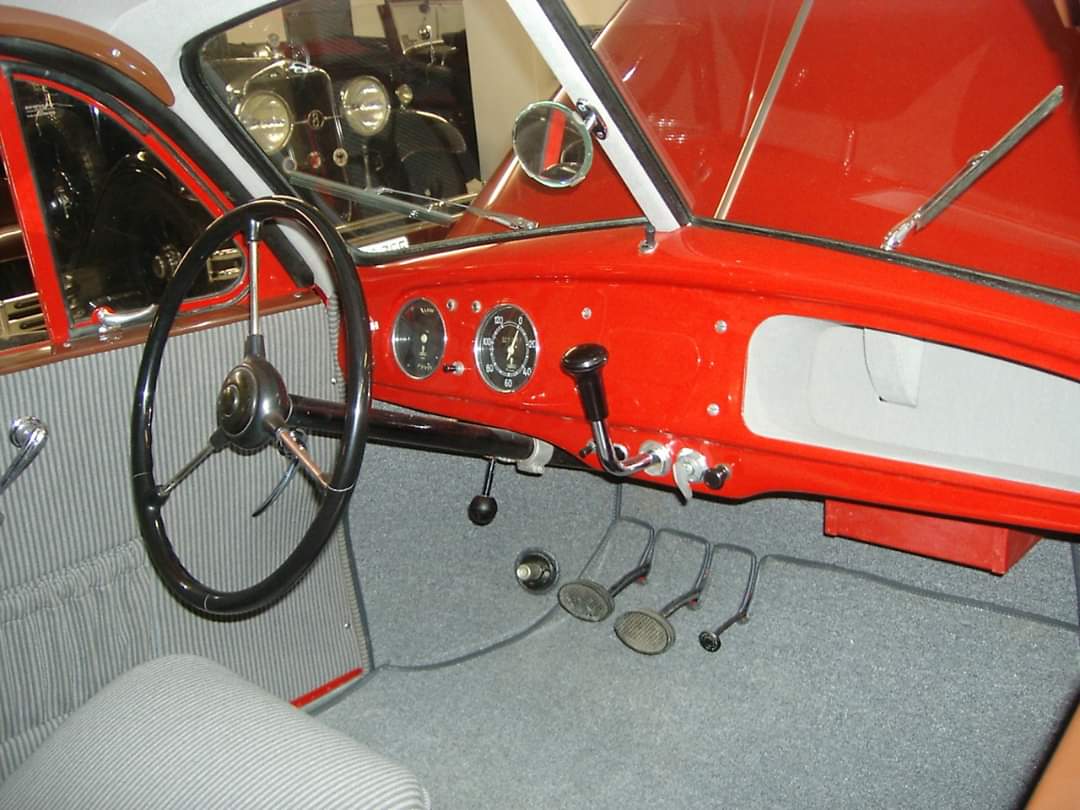
The car had been sitting for decades and required extensive rehabilitation. From an initial glance, I suspect there have been substantial modifications made to the car's dashboard and gear shift. The fascia and column mounted gear shift appear to come from a later, Eisenach-built F9, however, it could be that this was an early Eisenach assembled car using an IFA-built older body. A transitional example.

After due consideration, I decided not to proceed and ended up buying a 1953 DKW F89P instead. The long restoration process of that car is extensively documented in this blog.

I'm pleased to see however, that the owner of Buchan Motorsport has purchased this rare and interesting car. They have produced two every well-made and detailed videos about the F9 and its importance and this car makes a great, practical addition to their interest. I look forward to seeing more videos about the progress of the car's rennovation.

Part One - DKW F9 - The Forgotten Superstar

Part Two - DKW F9 - How it influences German car industry to today

Part Three - I Bought my own F9

Part Four - First Fixes

Part Five - How much F9 is in a VW Phaeton?

Part Six - Updates (rear lights and trunk)

Part Seven - Back in Black

Part Eight - New Look

Part Nine - Exterior Finished

Part Ten - New Brakes


The Buchan Motorsport documentaries:
https://dkwautounionproject.blogspot.com/2022/12/dkw-f9-forgotten-superstar.html
The history of the Development of the DKW F9:
https://dkwautounionproject.blogspot.com/2017/07/1939-dkw-f9-prototype.html
The history of the Development of the IFA F9:
https://dkwautounionproject.blogspot.com/2020/07/the-development-of-ifa-f9.html
The history of the Development of the DKW F89P:
https://dkwautounionproject.blogspot.com/2017/06/dkw-f89p-new-meisterklasse.html
Winfred Kuhl's IFA F9 prototype project:
https://dkwautounionproject.blogspot.com/2021/11/1948-ifa-f9-project-part-four-body.html

Tuesday, 9 November 2021

1948 IFA F9 Project - Part Four. The Body


There are car manufacturers who changed the design of their vehicles, often radically, many times in their history, such as Opel, Mercedes-Benz and basically every American company. Other car manufacturers kept to the same design for decades, making only small changes to small details, such as the Volkswagen Beetle, Citroen 2CV, British Leyland Mini and Renault 4. These cars are famous and legendary today, recognized all over the world because they retained their distinctive character. The F9, while neither famous nor legendary, belongs to this second group as it retained the same body shape from the time it was first revealed in 1939 until production stopped in 1964.

One thing I always found a little disappointing about these 'eternal' car designs was that the changes and updates that were made over time made them look more and more ugly. The windows became bigger for better vision, the body was widened for passenger comfort, more chromed trims were added to follow some fashion trends. While these changes fulfilled customers' rising expectations, the formerly pure and balanced original design of the car’s body was compromised.

So, for my F9 replica, I decided to 'go back to the roots.' In Zwickau they were very quick to completely revise the front, fenders and bonnet of the new car. The IFA-bible contains pictures of two pre-serial F9s, both from 1948, but with big differences in technical details and styling.

The car shown on pages 73 and 74 (above) retains the fenders and narrow bonnet of the pre-war prototype, with the gasoline tank in the back, small door handles and aluminum trim on the split window (my project).

The other version from the same year is shown on page 71 and has new IFA-fenders, the bonnet is 6cm wider, new bumpers, the gasoline tank mounted in the front, and bigger door handles. The reason for the existence of two different pre-serial cars lies - once again - in the separation of Germany and the 'cold war'. The body parts for the original prewar prototypes were produced by the Baur Karosseriewerkes in Stuttgart in what would become West-Germany and shipped to Auto-Union for assembly. Post-war, Zwickau was able to build their first F9 from spare and salvaged parts, but these were no longer available for the planned serial production. New body parts had to be manufactured from scratch, along with all the necessary pressing tools. This gave Zwickau engineers the opportunity to give the car a new face and address the numerous tight clearances within the engine compartment. The 'closed' position of the bonnet was set higher by 30mm. The front of the bonnet was made wider by 60mm, and the side walls of the engine compartment were set further apart.

Editor's Note – An Auto-Union memorandum exists from the pre-war development period noting that the narrow engine and gearbox clearances made repairs ‘in chassis’ extremely difficult. The use of a specially constructed spring engine hoist was essential for installing and removing the engine, thanks to which it took three men "only" four hours to remove the entire drive unit.

As there was no gasoline pump available in East Germany at that time, the gasoline tank was moved from the trunk into the engine compartment, using gravity feed like the prewar F8.

It is important at this point to review what was happening over in Ingolstadt in West Germany, where the new Auto-Union was attempting to revive their version of the DKW F9. As we know, Auto-Union lost their copy of the F9 when the British seized William Werner’s car in 1945. By a stroke of good fortune, Auto-Union recovered a set of complete, but damaged body presses from the tooling company, Allgaier, which enabled them to begin stamping out F9 body panels to fit over the prewar F8 chassis. This became the F89P New Meisterklasse, which went on sale in 1950. As this car was powered by the transverse mounted twin cylinder 700cc engine, Auto-Union too were forced to redesign the front end of the vehicle.

The pictures above show several attempts to update of the design on the prototype in Ingolstadt to differentiate it from the IFA F9, which went on sale a year earlier. These attempts eventually led to the serial version of F89P with the shorter bonnet and a new horizontal false radiator screen mounted across the car’s face. To provide more space for the long lower horizontal trims of this new radiator grill and the new big front bumper, it was necessary to set the front headlamps about 3cm higher than in the prewar DKW F9 prototypes. They set the lamps in higher position not by creating a new fender but by TURNING THE FENDER UPWARDS! The turning point was the lower corner of the fender, where it flowed into the door.

Understanding this process, I presumed the fenders of the F89P and the F9-prototype were produced by the same pressing tools from BAUR in Stuttgart, but the front corners of the F89P-version were cut off to fit the bumper and radiator grill, and the rear corner where the wing meets the door cut off slightly to account for the upturned mounting position.

The DKW F89P donor body came from Dieter Weingold's stockpile.

The next step was to cut the IFA bonnet down its central axis from the front almost to the end and push the front ends over each other in order to reduce the front aspect by 6cm, then weld together.

Internally, the side walls of the engine compartment were adjusted to the new fenders' positions.

My assumptions were immediately confirmed when I test mounted the IFA-bonnet onto the body after mounting the F89P-fenders in the original (F9) lowered position (with front lamps now 3cm lower). The closing lines of bonnet and fender fitted together as though these parts have always belonged to the same car.

The recreation now begins to look correct.

An early IFA F9 split rear window replaced the F89P rear window

The Dashboard.

The famous VW Beetle's marketing managers obviously weren't particularly keen on attracting more customers by providing their product with the latest in styling, design and technology. The Beetle was the last German car that was still equipped with a symmetric dashboard with two glove boxes and instruments arranged symmetrically left and right around the central axis. The Beetle's asymmetric dashboard was only introduced in 1953. The Beetle was also the last car still using mechanical direction indicators (Winkers) instead of indicator lamps (Blinkers). These were not changed until 1958.

When the shape and design of F9 were created in 1939, it was very modern to accentuate the central axis of the car body with split windows and shining trims on bonnet and between the split front glass.

I did not consider using a dashboard from an F89P or IFA F9 from 1954 or later although these were readily available.

The red 'Werner car', as has been restored today, has something like that, which is kind of disappointing as it is not correct to the photographs we have of the F9 prototypes.

There were only two possibilities for my project – manufacture an F9-prototype dashboard as seen in historical pictures or obtain an F9 serial dashboard as shown in IFA DKW F9 parts list from 12\1951. I chose the serial one for three reasons:
1. I had the good fortune to borrow an original one from German DKW-enthusiast Henryk Kindt (the only one I’ve ever seen in my life as they are very rare). He gave me permission to restore it and let Beauvary GmbH in Aachen, Germany, reproduce it.

2. The rear-view photograph of the pre-serial IFA F9 from 1948 (my car) in the IFA-bible page 74 shows us that the car show it was already equipped with this new serial dashboard.

3. When I made the arrangement with Henryk Kindt in 2015, the Estonian F9 had not yet be discovered. Despite the significant modifications this car has been through, the car still has the original F9-prototype dashboard. It would have been a nice idea to reproduce this one, too.

Undoubtedly, Auto-Union planned a completely symmetric F9-dashboard, but for the IFA F9, the left-hand glove box is smaller size than that one on the right side. This was a consequence of the necessity to move the gasoline tank into the engine bay. This left no space for the wiper engine.

Beauvary GmbH in Aachen (www.beauvary.com) offers 'small-batch 3-D formed sheet metal manufacturing for boats, oldtimer parts, art and design objects.' This wasn't any kind of cheap solution and required a lot of manual after-work, but I finally got exactly what I wanted. Knowing the early F9 would attract more enthusiasts soon, I let Beauvary produce 5 pieces.

Test fitting the dashboard

After painting (by my ten year old son), the result is marvelous.

The Bumpers.

There are obvious differences with the bumpers on the Werner car, as restored, which were obviously tinkered with by some apprentices in the Audi museum workshop by looking at the historical pictures.

I found two prewar bumpers in Dieter Weigold's massive collection of parts that fitted the car perfectly. These are real historical car accessories from the manufacturer, Friese. Friese manufactured bumpers for the DKW F7 and F8 before the war, as well as the Mercedes-Benz 170 and Audi and Wanderer cars.

And fitted, they look perfect.

Unfortunately I was missing the bumper horns so I had to call on Beauvary’s service again.

The molds for the horn templates were carved in hard rubber.

Rear view of the car

By Winfried Kuhl

The IFA F9 Project Part One - https://dkwautounionproject.blogspot.com/2021/08/1948-ifa-f9-replica-project.html

The IFA F9 Project Part Two - The Engine - https://dkwautounionproject.blogspot.com/2021/09/1948-ifa-f9-replica-project-part-two.html

The IFA F9 Project Part Three - The Chassis - https://dkwautounionproject.blogspot.com/2021/09/1948-ifa-f9-replica-project-part-three.html

Development of the IFA F9 - https://dkwautounionproject.blogspot.com/2020/07/the-development-of-ifa-f9.html

1953 Overview of the development of the IFA F9 - https://dkwautounionproject.blogspot.com/2021/09/1953-deutsche-und-auslander.html

1954 IFA F9 Ersatzteilelist - https://dkwautounionproject.blogspot.com/2021/12/1954-ifa-f9-ersatzteilelist.html

Wednesday, 29 September 2021

1948 IFA F9 Replica Project - Part Two. The Engine


In Part Two of the IFA F9 Replica project, Winfred Kuhl explains the development of the post-war F9 engine and his search for an early example

Prologue – it was recognized at the outset of the Hohnklasse project in 1938 that DKW’s workhorse 700cc twin-cylinder engine had reached its developmental limits. The CA700 engine, generating 20 horsepower, used in the F7 and F8 cars was operating at its peak. The company had attempted to develop the engine further by uplifting its capacity to 550cc per cylinder, but performance left a lot to be desired and the resulting ZW1100 engine was relegated for industrial use only.

Having decided on the development of a new three-cylinder engine, Director of Sales, Carl Hahn, demanded the construction of a test engine as cheaply and quickly as possible. The engineering team achieved this by cutting one twin-cylinder engine in half and grafting a third cylinder onto a two-cylinder engine block. This resulted in an engine with a slightly asymmetric piston layout, with the two outer pistons being mirror images. The asymmetric layout was not ‘planned’ per se, but an incidental feature of this tactical development process. This asymmetrical layout was then copied into later prototype engines, the pre-production series and all later post-war DKW 3=6 engine series right through to the retirement of the Munga in 1968.


In the east however, in the aftermath of the war, developments took another path. The 'IFA-Bible' (Plaste, Blech und Planwirtschaft by Peter Kirchberg, 2000) tells us that the triple cylinder engine block design went through several significant changes. Chemnitz engineers had discretely salvaged whatever was salvageable from the wrecked F9 cars at Saupersdorf, which was not much. Behind the backs of the Soviet occupation authorities, parts, tools and design documents were retrieved from where they had been hidden and planning began on restarting vehicle production. However, having lost virtually all of their machine tools as a result of seizure by the Soviets, the engineers were forced to improvise. In order to make serial production easier, the engineers simplified the engine block construction and symmetrically aligned the layout of the pistons. This change allowed IFA to use three identical pistons, while DKW would continue with two identical and one mirror-inverted (DKW 1939 - 1965). A critical factor driving these changes was the need to convince the Soviets that IFA would be able to quickly recommence car production, and thereby avoid liquidation of the company. Approval to recommence car production was granted at the beginning of 1947.

The second change affected the clean-up openings for the exhaust ports and the transfer ports for the fuel mix, which were removed completely. This change would also occur in Ingolstadt too, for the two-cylinder block of the F89, but not until after 1950.

Attracted by the better designed prewar-version of the F9 and with my expanding knowledge of the intriguing technical details, I began to focus more of my attention acquiring a prewar engine, hoping that maybe more had been produced than the three pieces mentioned in the 'IFA-Bible'....

In all my years visiting markets for oldtimer car parts in the eastern part of Germany - and this was over 30 years! - I never saw a single early IFA three-cylinder-engine for sale. It surely would have attracted my attention as it would have more than 8 bolts in the engine-block for the attachment of the head or an engine with a distributor for the three cylinders' ignition cables. However, these engines were always rare due to the extremely low production numbers of the early IFA F9 and the fact that early engines would later have been replaced by more modern ones. At the time though, I did not know anything about these engines and only became interested in them in 2012.

Using the internet, I was able to get an idea of what the original engine and gearbox would have looked like. Then, after much searching, I found an early IFA-engine for sale in Chemnitz of all places! This was the first engine that I purchased, and it turned out to be the most interesting because the cylinder head and the distributor gear mechanism were very early products, documented in the spare parts list from December 1951 as 'old version.'

Much later, the same seller offered an F9-gear box which obviously came from the same car as the engine I had bought because it was very early too. It was equipped with bearings from the West German bearing manufacturer, Fichtel and Sachs, in Schweinfurt. This means this engine was built at a time when the border between the two parts of Germany wasn't complete closed and trade was still possible. The border became increasingly restricted during 1951 due to the western Allies’ plan to weaken and boycott the eastern European countries whenever possible, after Stalin definitively denied the west further access and influence. The so-called 'Cold War' had begun...

Due to my job as a manufacturer of wooden bodies for prewar DKWs from 1999 and 2020, I made the acquaintance of lots of DKW-fans from all over Germany. Most of them were from eastern Germany, because - another effect of the 'Cold War' - in eastern Germany many wooden bodied DKWs remained in daily use right into the late eighties. Some of them even crossed to the west after the internal border with western Germany opened on the 9th of November 1989, where they became curiosities in car dealers' lots. Consequently – necessity being the mother of invention - the eastern Germans were much more skilled in using and repairing old cars than their western counterparts and that is why the hobby of restoring cars is much more popular in the eastern part of Germany than in the western one.

From the time I became interested in the F9, I used all my connections and friends from the DKW clubs, meetings and parts-markets to search for a prewar F9-engine as mentioned in the IFA-Bible and as can be seen in the F9 at the Audi Museum, Ingolstadt.

Then in 2014, I got a tip from someone that he saw such an engine block in a shop window in a little town somewhere between Zwickau and Chemnitz. When I showed up there, it was immediately clear that the owner did not want to sell the engine, but he was otherwise very nice and allowed me to take photos while he told me the story.

The house had been a DKW-workshop in the years 1935-1962, run by his grandparents and parents. The engine had been found under a wooden floor during renovating works on the house in the 1980s. It emerged that the grandparents had hidden it there from Soviet soldiers, who were 'fond of each piece of metal they could get in their hands' in those days. The engine had then been forgotten until it was rediscovered during the renovation.

In the Auto-Union Veteran Club magazine 'Clubnachrichten' Vol 172 April 2018, Audi Tradition historian, Ralf Friese, advised that the DKW pre-production engine blocks received serial numbers 429801V - 429900V and at least 49 examples were built.

The engine from under the floorboards however is stamped number 525269V, significantly far from the official series. We know that this is not a serial production engine as it is stamped with V, for the German word Versuch, meaning ‘Research’, which means this engine was destined for experimental purposes. In July 2018 I confirmed with Thomas Erdmann, the historian from Audi Tradition, that there was no way to relate this number to any experimental projects at Auto-Union before 1945....

Is it possible that this engine drove one of the three pre-series F9 that were constructed in Zwickau in 1948? This is what we will talk about in the following chapters.
Winfried Kuhl

The 1951 engine fitted in the chassis.

The IFA F9 Project Part One - https://dkwautounionproject.blogspot.com/2021/08/1948-ifa-f9-replica-project.html

The IFA F9 Project Part Three - The Chassis - https://dkwautounionproject.blogspot.com/2021/09/1948-ifa-f9-replica-project-part-three.html

The IFA F9 Project Part Four - The Body - https://dkwautounionproject.blogspot.com/2021/11/1948-ifa-f9-project-part-four-body.html

Development of the IFA F9 - https://dkwautounionproject.blogspot.com/2020/07/the-development-of-ifa-f9.html

1954 IFA F9 Ersatzteilelist - https://dkwautounionproject.blogspot.com/2021/12/1954-ifa-f9-ersatzteilelist.html
1956 IFA F9 Owners Repair manual - https://dkwautounionproject.blogspot.com/2020/07/the-development-of-ifa-f9.html

79Oktan have an exclusive reprint of Peter Kirchberg's "Plaste, Blech und Planwirtschaft" here: https://79oktan.de/shop/detailview?no=B0018


Saturday, 10 November 2018

1971 Wartburg in Eisenach 75th Anniversary


In 1971 the Eisenach Motorenwerkes celebrated its 75th year anniversary. To commemorate this milestone they produced a folder of the vehicles they had produced, from the original Wartburg of 1896 to the VEB Wartburg 353. I have part of one of these packs showing a range of the Eisenach products, ranging from the first Wartburg, to the DIXI, then the BMW and EMW years to the late VEB Wartburgs.


1898 Wartburg wagen

The first Wartburg car was based on the Benz Victoria.


1904 Dixi S12

In 1904 the company changed its brand-name to Dixi.


1907 Dixi U35

Dixi produced a range of rather conventional four cylinder cars during the Edwardian period.


1928 Dixi DA1

Dixi rebuilt its fortunes in the interwar years by manufacturing the English Austin 7 under license (the DA meant Dixi-Austin). By the 1930s Dixi had made substantial changes to the original Austin 7 model, turning it into a completely different car.


1935 BMW 328 Sportswagen

In 1928 the motorcycle manufacturer BMW was looking to expand into car production and purchased the struggling Dixi Eisenach works. BMW made substantial changes to the Dixi-Austin 7 model and by the early 1930s converted it into a handsome sportster. A version of the BMW 328 was even built in Britain under the brand name BMW-Fraser Nash.


1945 BMW 321

BMW introduced the 321 prior to World War II, but it was only after the war that the car was produced in any numbers. From 1945 to 1948 the car was built at the Eisenachwerkes in East Germany, mainly from pre-war spares and left over parts, under the BMW name. In 1948 the East German government nationalised all surviving motorworks under the VEB conglomerate. BMW management lost their claim on the Eisenach factory, who's products were thereafter rebadged under the EMW brand.


1953 AWE Sportswagen

VEB attempted to capitalize on BMW's prewar motorsport tradition in the early post-war years. The AWE sportswagen was a six cylinder four stroke engine racer that participated in Grand Prix racing.


1953 IFA F9

In 1953 VEB transferred the manufacture of the IFA F9 from the old Auto-Union plant at Chemnitz to Eisenach, as Eisenach was under-utilized at that time. This decision put an end to Eisenach's BMW heritage. From now on all Eisenach's vehicles would be powered by two-stroke DKW developed engines.


1956 Wartburg 311

From 1950 t0 1953, DKW in West Germany and IFA in East Germany were producing their own versions of the prewar DKW F9 (as the DKW F89P and the IFA F9 respectively). Once manufacture of the IFA F9 was handed over to Eisenach, the many problems with the early Chemnitz-built cars were quickly addressed and the F9 became a solid export earner. DKW in West Germany were threatened by this development and so sued IFA for patent infringement of the F9 body design. To get around the patent issue, Eisenach gave the car a completely new and modern pontoon body and renamed the car the "Wartburg 311" The Wartburg 311 was a much better car than its DKW and IFA predecessors.

1966 Wartburg 353

In 1966 the Wartburg received a comprehensive makeover. Styling was contemporary - and square! The car was an outstanding success and sold over a million vehicles. Although VEB attempted to update and improve the car over the years, government funding was never forthcoming so only small, progressive improvements were made the years. Nevertheless the Wartburg 353 remains a solid car which still performs well to this day. Many thousands remain on the road.


1974 Wartburg-Eisenach magazine


Videos and Links

A documentary covering the postwar years of BMW East, EMW and VEB IFA.

Contemporary footage of the AWZ racer at work and then the Wartburg and P70 cars.